Turning Git Data into Actionable Team Insights
Engineering teams sit on a goldmine of objective activity data in Git. Here is how Tempo, ScreenJournal's engineering analytics (launching soon), is designed to turn commits, pull requests and issues into proactive, actionable insights.
Turning Git Data into Actionable Team Insights
Updated on 8 July 2026
Git is the single most objective record of your engineering team's daily activity. Every line of code, every decision, every fixed bug is logged, timestamped and attributed. Yet, for most teams, this massive repository of truth remains largely ignored, treated only as a version control system and not the powerful business intelligence tool it truly is.
This oversight is costing teams time and efficiency.
The solution lies in moving beyond the raw repository and turning the metadata of commits, pull requests (PRs) and issues into proactive, actionable insights.
Commit vs Manual Standup
Traditional daily standups rely on human memory and interpretation. A developer is asked to report progress, but human nature and the desire to be perceived as productive can often compromise the accuracy of that report. The result is:
- Subjectivity and misrepresentation: Status updates are often optimistic, incomplete, or, in worst-case scenarios, inaccurate. Developers may feel pressure to report progress that hasn't materialised, leading to a false sense of security for project management.
- Forgetting: Critical context or small fixes are frequently omitted because developers simply can't recall every detail from 24 hours prior.
- Time sink: Fifteen minutes of status updates across a large team is a drain on engineering time.
In contrast, the commit is an automatic, objective and detailed record of the work done, when it was done and what the scope of that change was. It is the unvarnished truth of progress.
This is the data source for your next standup. By aggregating commit messages, timestamps and branch activity, an analytics system can draft a succinct, reliable report: "What I did yesterday," "What I'm blocked on," and "What I plan to do today," all backed by code activity. This is designed to replace time-consuming manual status checks with immediate, data-backed clarity, drafted when you ask rather than pushed at you. If you want to see how this fits together, we cover the approach in more depth in our guide to AI standups.
Auto-Detecting Blockers from PR and Issue Activity
The real power of Git analytics isn't just knowing what was finished; it's proactively identifying what's stuck. While the commit is the record of completion, the issue and pull request (PR) are the arenas where friction, delay and blockers occur. By analysing the activity surrounding these artefacts, teams can automatically flag risks long before a developer has to raise their hand.
The failure to track this activity means major delays often remain hidden until the next standup, or worse, until the project is late.
The Workflow Blocker: Stalled Pull Requests
A PR is a request for review, the handoff point where individual work meets team collaboration. Delays here are almost always process or capacity blockers.
- Time-to-merge (cycle time): Exceeding the team's merge threshold signals a process bottleneck and is used as a core review metric for organisational efficiency.
- PR comment mentions and dependencies: An @mention of an external team or "blocked by" language creates an external dependency alert for proactive resolution.
- Individual reviewer load: Quantifying PR reviews provides objective context to balance team capacity, not a scoreboard to police.
- Code churn: The number of follow-up commits after a PR opens is a coaching signal about initial code quality and review efficacy, best read in context.
The Silent Blocker: Issue Activity vs. Code Activity
Issues (tickets) are the roadmap, but the discussion around them often reveals the actual difficulty. An intelligent system tracks the relationship between dialogue and delivery.
- Discussion volume on issues: High comment volume with little associated code activity can point to a "silent blocker" worth a manager's attention.
- Issue ageing: A lack of activity on an "in progress" ticket can prompt a check-in, preventing the task from becoming silently forgotten technical debt.
How Tempo is Designed to Turn Git Data into Actionable Team Insights
Tempo is ScreenJournal's engineering analytics, its Claude Code and engineering angle, and it is launching soon. ScreenJournal is an AI work visibility tool that reads on-screen work as it happens, turns it into a detailed timeline of what each person actually did, and then, by default, deletes the raw screen data. Timelines accumulate into a searchable chronicle of everyone's work history, and from them ScreenJournal generates timesheets and reports automatically and drafts standup summaries on request, answering questions about any of it in plain English. Tempo is designed to read the local repository and Claude Code's session files, then turn that raw signal into the insights below. You can read more about where it fits on our engineering teams page.
Standup Summaries on Request
Tempo is designed to analyse commit messages and daily activity to draft a standup summary you can pull on request, so a reliable, code-backed update is ready when you need it rather than reconstructed from memory. In ScreenJournal today you can already ask for a standup draft on request through Ask AI chat or the MCP integration; a standup is drafted when you ask for it, never sent automatically.
Effort in Context
Tempo is designed to analyse Git activity (commits, file changes and similar signals) and estimate developer effort. The aim is to give teams objective context for how effort is distributed and to surface where someone may be tracking below their own historical baseline, so a manager can check in and remove blockers. Scores are contestable, and engineers see the same picture their managers do, so the data informs supportive conversations rather than a ranking.
Blocker Detection
Tempo is designed to watch key process metrics like PR cycle time and issue discussion volume to help surface silent blockers and stalled workflows. The aim is to ensure friction is surfaced and addressed sooner, supporting quicker cycle times and reduced project risk.
Because Git is only part of the story, ScreenJournal also builds work timelines from on-screen work, reading it as short-lived video, writing down what each person actually did, and by default deleting the raw screen data during processing. Together, the code record and the work timeline give a fuller picture than either alone.
Frequently asked questions
Can you generate standups from git commit history?
Yes. Commit history is a timestamped record of what was done, so it makes a reliable basis for a standup. In ScreenJournal today you draft a standup on request through the Assistant chat or the ScreenJournal MCP, and Tempo is designed to draft one from your Git history when it launches. Standups are drafted when you ask, never sent automatically.
How does pull request cycle time signal a blocker?
When a pull request's time to merge exceeds the team's normal threshold, it usually points to a process or capacity bottleneck rather than slow coding. Long review waits, back-and-forth comments and repeated follow-up commits are friction signals, so a rising cycle time is an early flag that work is stuck and needs attention.
What is git analytics for engineering teams?
Git analytics reads the metadata your team already produces, from commits and pull requests to issue activity, and turns it into insight about progress and friction. Instead of treating Git as version control alone, it surfaces stalled reviews, silent blockers and effort patterns, giving managers objective context rather than relying on memory or optimistic status updates.
What is Tempo?
Tempo is ScreenJournal's engineering analytics, and it is launching soon. It is designed to read the local repository and Claude Code's session files to analyse AI-assisted coding sessions, draft code-backed standup summaries on request, and surface blockers like stalled pull requests and ageing issues from your Git history.
What are you waiting for?
Tempo is launching soon. To be first in line for code-backed daily standups and effort insights built from your Git history, explore ScreenJournal for engineering teams.
Stop guessing. Start knowing.
Let AI turn screen data into clear insights. Start your 2 months free trial
Related Posts
Automated Standups for Engineering Teams: How They Work
Automated standups draw the daily update from real work like git activity and on-screen output, so engineers stay aligned without the context-switch of writing it by hand.
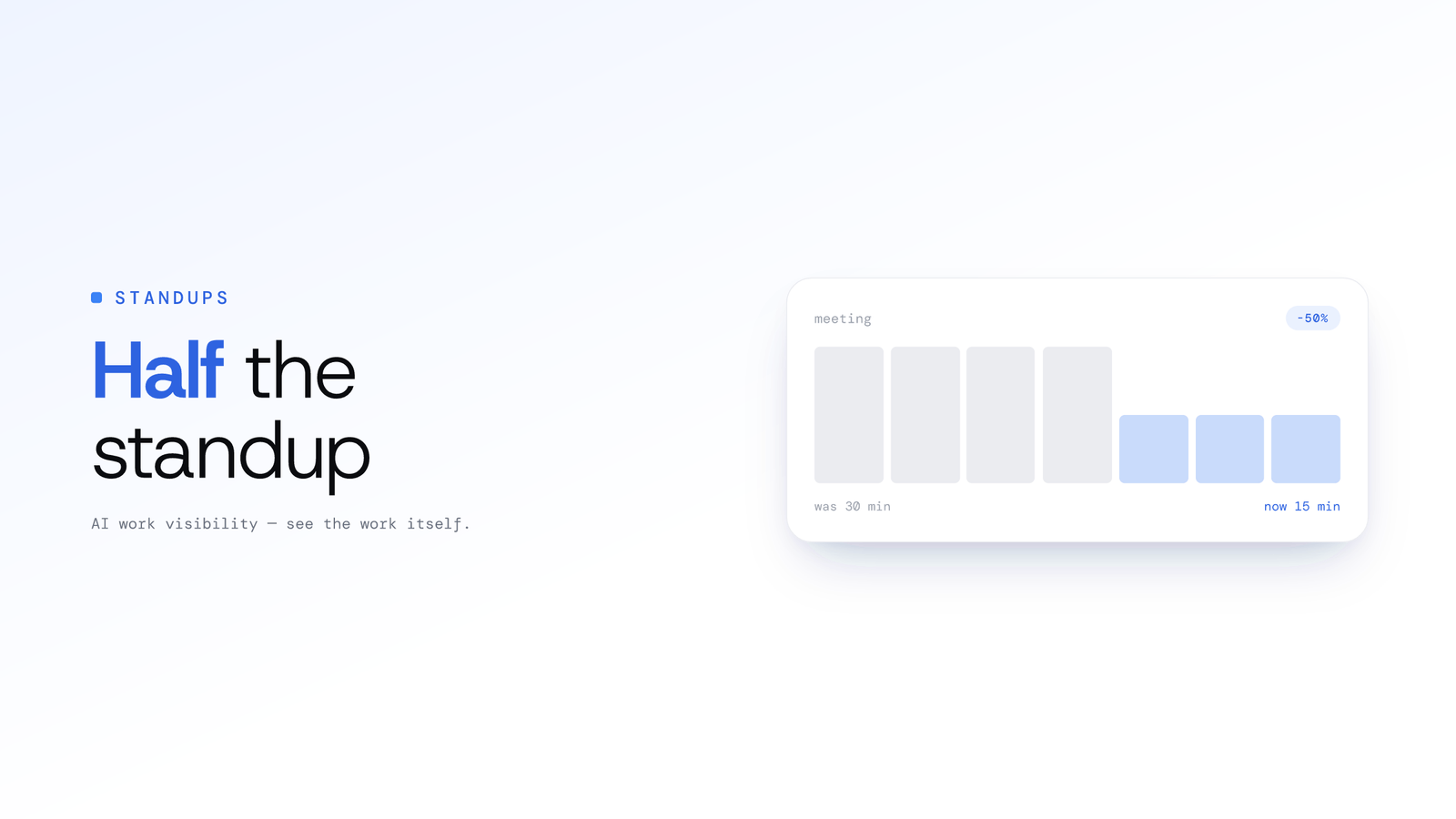
How to Cut Daily Standup Time in Half Without Losing Context
Cut daily standup time in half with three approaches: asynchronous updates, automated summaries from real work, and a hybrid model that keeps context intact.
Why Engineering Managers Spend Too Much Time Chasing Updates
Engineering managers chase status updates because tools hide real progress. Ask the derived work record instead of pinging developers, and the meeting shrinks.