Can AI write my standup?
Updated on 14 September 2026
Yes. If your workday is already recorded as a timeline, an AI can write an honest standup from it. Ask ScreenJournal's chat or the ScreenJournal MCP and yesterday's update is drafted from what you actually did, so nothing gets forgotten or inflated. You glance, tweak a word and post.
How does ScreenJournal write my standup?
From the day itself, in three steps.
- Your day is recorded as a timeline. ScreenJournal reads on-screen work as it happens and writes a work timeline: which app, what was done, how long it took, with a productivity score. Apps and sites on the organisation's privacy exclusion list, such as banking, payroll, HR and health, are never captured.
- The footage goes, the record stays. A frontier AI model derives the timeline entries, PII is removed during processing, and by default the raw screen data is deleted during processing; a manager can opt in to Evidence Mode where video evidence is needed. What the standup is drafted from is a plain-English account of the day, not screenshots.
- You ask, and the standup is drafted from yesterday's entries. Ask the built-in Ask AI chat, or the ScreenJournal MCP from whichever AI tool and model your team prefers. What moved, what shipped, what is still open: you read it, adjust anything, and post it.
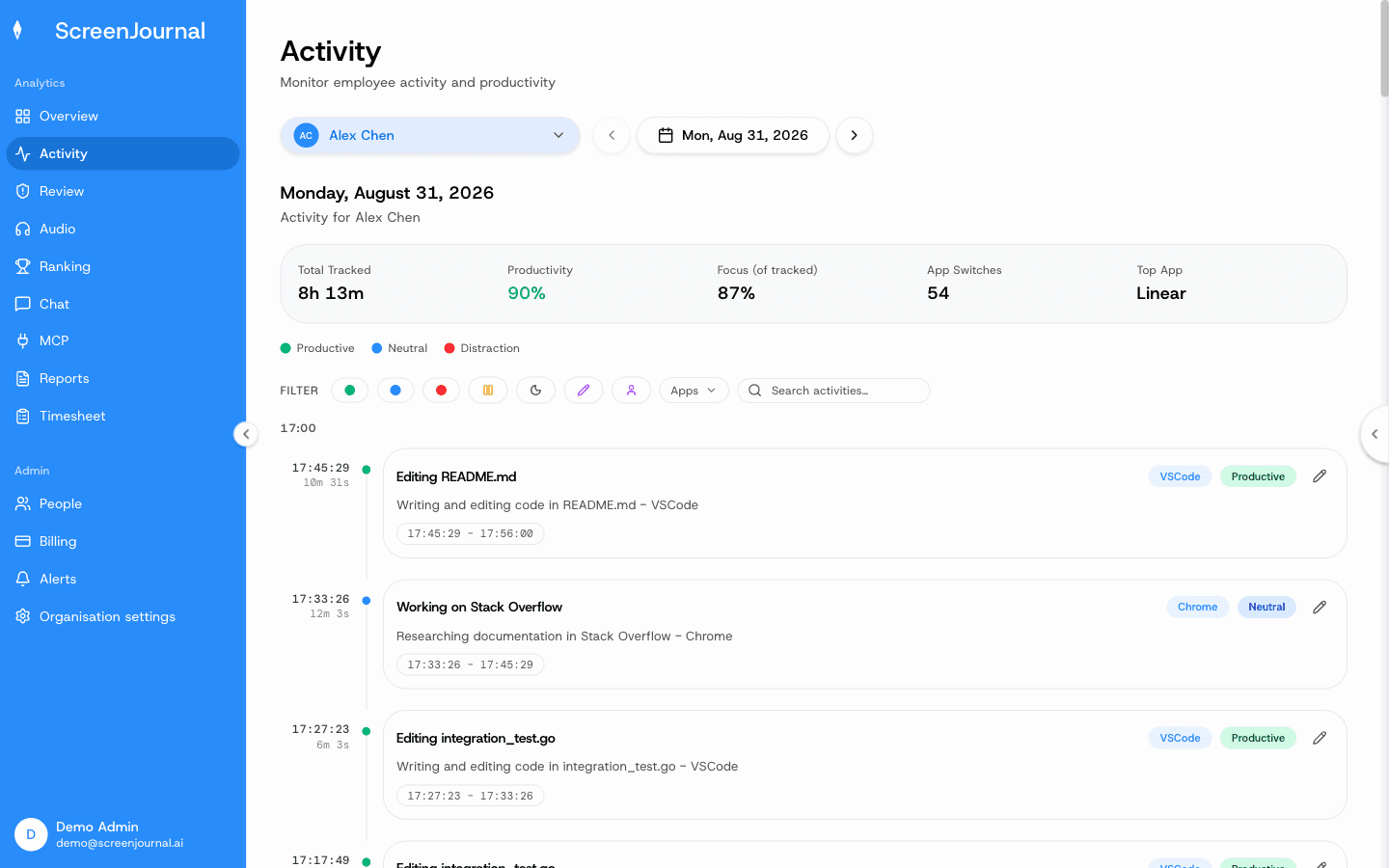
Proof: the Activity page, one person's day as scored segments with the app, time range, duration and an AI-written description; hover a segment for Correct score, Play recording and Redact, each gated by role and policy.
What does an AI-written standup look like?
It reads like the update you meant to write, with the details you had already forgotten. Because it is drafted from timeline entries rather than recollection, it is specific: it names the actual work, not a vague "continued on the project". An illustrative draft:
Yesterday: reviewed the payment-retry PR, shipped the fix for the invoice rounding bug, drafted the Q3 capacity doc. Today: capacity doc review, then the webhook migration. Blocked on staging access for the migration test.
Every line traces back to entries in the timeline. Your part of the standup becomes a fifteen-second review: glance, tweak a word, post.
Are AI standups more accurate than ones written from memory?
Yes, because they are written from a record of the work rather than a reconstruction of it. Memory favours whatever was recent, dramatic or still unfinished. The small things vanish first: the code review that unblocked a colleague, the twenty-minute production fix, the third bug of the afternoon. A timeline keeps them all.
It is honest in the other direction too. An update drafted from real entries cannot quietly inflate a slow day, and it does not need to, because the record already gives quiet work its due. Someone who shipped excellent work in two focused hours is finally visible, and someone reciting yesterday's plan as today's progress is not. Timer-based trackers cannot offer this, because they approximate effort from mouse and keyboard activity rather than reading the work; the honest comparison is in ScreenJournal vs screenshot trackers.
Do AI standups work for async and distributed teams?
Yes, and distributed teams are where they help most. When a team spans time zones, yesterday's update can be drafted from the timeline the moment your day starts, with no waiting for someone else's morning. Handovers stop depending on what people remembered to write down at midnight.
Follow-up questions do not need to wait for the next meeting either. Timelines accumulate into a searchable work chronicle, so "what happened with the migration this week" is a question for Ask AI or the ScreenJournal MCP, answered in the moment and scoped to your role's permissions.
Who are AI standups for?
Any team that reports progress out loud or in a thread. Engineering teams get updates tied to what actually shipped, including visibility into AI-assisted coding sessions. Agencies and client-facing teams get a daily account that matches the timesheet, because both are generated from the same record. Offshore and BPO teams get updates across the time-zone gap without waiting for anyone's morning. Hybrid and remote teams get a status ritual that takes seconds instead of a meeting. It works in any industry where work happens on a computer.
Frequently asked questions
What is ScreenJournal?
ScreenJournal is an AI work visibility tool that reads on-screen work as it happens, turns it into a detailed timeline of what each person actually did, and then, by default, deletes the raw screen data. Timelines accumulate into a searchable chronicle of everyone's work history, and from them ScreenJournal generates timesheets and reports automatically and drafts standup summaries on request, answering questions about any of it in plain English.
Can I edit my standup before anyone sees it?
Yes. The draft is yours to review, change or rewrite before you post it. Employees see the same activity view managers do, excluded apps and sites are never captured, and anything can be redacted when the organisation allows it.
Does AI watch my screen to write the standup?
It reads on-screen work as it happens, derives the timeline, and then, by default, the raw screen data is deleted during processing. No screenshots are taken, and no video is stored unless a manager has opted in to keep video evidence for the organisation or a team, in which case recordings are stored for up to 3 months. The standup is drafted from the timeline either way.
Can AI standups replace the standup meeting?
They replace the recitation, not the conversation. The status round that eats the first ten minutes becomes a quick request to the assistant before the call, so what remains is the part that needed humans anyway, meaning decisions, blockers and help. Fully async teams can post the updates and skip the call entirely.
Can someone fake an impressive standup?
Not easily. The draft is generated from the work itself, so an impressive update needs real work behind it. Activity tricks that fool timers, like mouse jigglers, add nothing to a timeline that measures output rather than motion.
See the work itself, not screenshots of it
Timesheets, reports and answers from the work your team actually did. Available for Windows and macOS, with Linux and mobile support coming soon.