Measuring Engineering Effort, Not Lines of Code
Lines of code is a broken proxy for productivity. Tempo, ScreenJournal's engineering analytics, is designed to read contextual Git activity so you can surface real effort and coach engineers on the value they deliver.
Measuring Engineering Effort, Not Lines of Code
Updated on 8 July 2026
In the complex world of software engineering, understanding genuine effort is often clouded by outdated metrics and subjective feelings. The developer who appears perpetually "busy" might be delivering less value than the one quietly shipping clean, efficient code. Tempo, ScreenJournal's engineering analytics (launching soon), is designed to move beyond vanity metrics and derive context and true effort from Git activity, so managers can support and coach their teams on the value they deliver rather than the volume of code they produce.
Tempo is part of ScreenJournal. ScreenJournal is an AI work visibility tool that reads on-screen work as it happens, turns it into a detailed timeline of what each person actually did, and then, by default, deletes the raw screen data. Timelines accumulate into a searchable chronicle of everyone's work history, and from them ScreenJournal generates timesheets and reports automatically and drafts standup summaries on request, answering questions about any of it in plain English.
The End of the Lines of Code (LOC) Fallacy
For decades, Lines of Code (LOC) has been the default, yet deeply flawed, proxy for developer productivity. The philosophy behind Tempo rejects this metric for several critical reasons, because measuring by volume actively encourages the wrong behaviour:
- It punishes quality work: LOC fails to capture one of the highest-value engineering activities: refactoring. A great developer often removes hundreds of lines of complex, legacy code to replace it with a dozen lines of clean, simple logic. LOC metrics would register this crucial simplification as "negative productivity."
- It rewards bloat and inefficiency: When measured by LOC, developers are incentivised to write verbose, padded implementations, inflate their code volume with unnecessary comments, or avoid using efficient libraries and frameworks. This results in technical debt and increased maintenance costs, which is the opposite of high performance.
- It ignores complexity: A single-line change to a core security function might require days of research, testing, and architecture review, delivering immense value. A one-hundred-line change to boilerplate UI code might take an hour. LOC treats these two tasks as being 100-to-1 in value, which is demonstrably false.
Estimating True Effort with AI
Tempo is designed to replace the flawed quantitative approach of LOC with a smart analysis powered by frontier AI models. The aim is not to count activity but to read and understand it.
Because Tempo is ScreenJournal's Claude Code and engineering analytics, it is designed to read the local repository and Claude Code's session files to analyse relevant development artefacts and produce a contextual Effort Score:
- Code context analysis: The model processes the content of commits, PR descriptions, and issue summaries. It is designed to recognise when a small code change resolves a complex, critical bug versus when a large code change is simply a routine feature addition.
- Complexity recognition: By analysing the structure and content of the codebase where the changes are made, the model can estimate the cognitive complexity of the task, so a developer who solves a thorny problem with minimal code is credited for the value delivered rather than penalised for a low line count.
The point of this score is to make effort visible and discussable, not to rank people against one another. An admin can correct any score, and engineers see the same picture their managers do, so the conversation stays about the work.
Surfacing Real Effort and Engagement Patterns
Tempo is also designed to give managers a fairer view of engagement over time, drawn from consistent Git activity (commits, reviews, comments). The goal is to open supportive conversations, not to catch individuals out.
- Sustainable pace: By reading the frequency and timing of meaningful contribution signals, Tempo is designed to surface where someone's engagement looks unusually low, which is often an early signal of blockers or unclear priorities rather than a lack of effort.
- Patterns over snapshots: Tempo is designed to distinguish normal fluctuations (an occasional sick day, a week spent in design reviews) from longer-running patterns worth a conversation. This gives managers objective context to check in, remove blockers, and coach, rather than guesswork to police.
Used well, this is a coaching tool. It helps a manager notice when a strong engineer has quietly taken on the hardest problem in the sprint, and when someone capable seems stuck and could use support. Because the effort view is built from work over time, it reads best alongside the work timelines ScreenJournal already writes, so a fair number always has the story behind it.
How ScreenJournal Fits In
Tempo is the engineering-specific angle, and it is launching soon. In the meantime, ScreenJournal already helps teams see what actually happened in a day: it reads on-screen work as short-lived video, writes a timeline of what each person actually did, then by default deletes the raw screen data during processing. When you need a summary, ScreenJournal can draft a standup on request through Ask AI chat or MCP, so the write-up reflects the real work instead of a hurried recollection.
To see how Tempo will bring this together for engineering teams, take a look at what we are building for engineering teams.
Frequently asked questions
Why are lines of code a poor measure of developer productivity?
Lines of code rewards volume over value. It scores a padded, verbose implementation as productive and treats a clean refactor that deletes code as negative. It ignores how hard a change was, so a one-line fix to a critical bug counts for less than an hour of boilerplate. It measures typing, not value delivered.
What is a developer effort score?
A developer effort score estimates the real effort behind a change rather than its size. It reads the context around commits, pull requests and issues to recognise when a small change solved a hard problem, so a difficult fix is credited for the value it delivered rather than penalised for a low line count.
How can managers measure developer productivity fairly?
Measure outcomes and effort in context, not raw output. Look at what a change achieved, keep every score correctable by an admin, and let engineers see the same picture their managers do. Used this way, the data opens supportive conversations about blockers and workload instead of ranking people against one another.
What is Tempo?
Tempo is ScreenJournal's engineering analytics, and it is launching soon. It is designed to read the local repository and Claude Code's session files to give deep analysis of AI-assisted coding sessions, turning contextual Git activity into an effort view that credits the value a change delivered rather than the volume of code produced.
What are you waiting for?
Head to screenjournal.ai to see how ScreenJournal surfaces real work, and to be first in line when Tempo launches.
Stop guessing. Start knowing.
Let AI turn screen data into clear insights. Start your 2 months free trial
Related Posts
Turning Git Data into Actionable Team Insights
Engineering teams sit on a goldmine of objective activity data in Git. Here is how Tempo, ScreenJournal's engineering analytics (launching soon), is designed to turn commits, pull requests and issues into proactive, actionable insights.
The Death of the Daily Standup: Why Asking What Did You Do Yesterday Is Obsolete
The daily standup status report is obsolete. Let git activity answer what did you do yesterday, so the standup meeting is for blockers, not recitation.
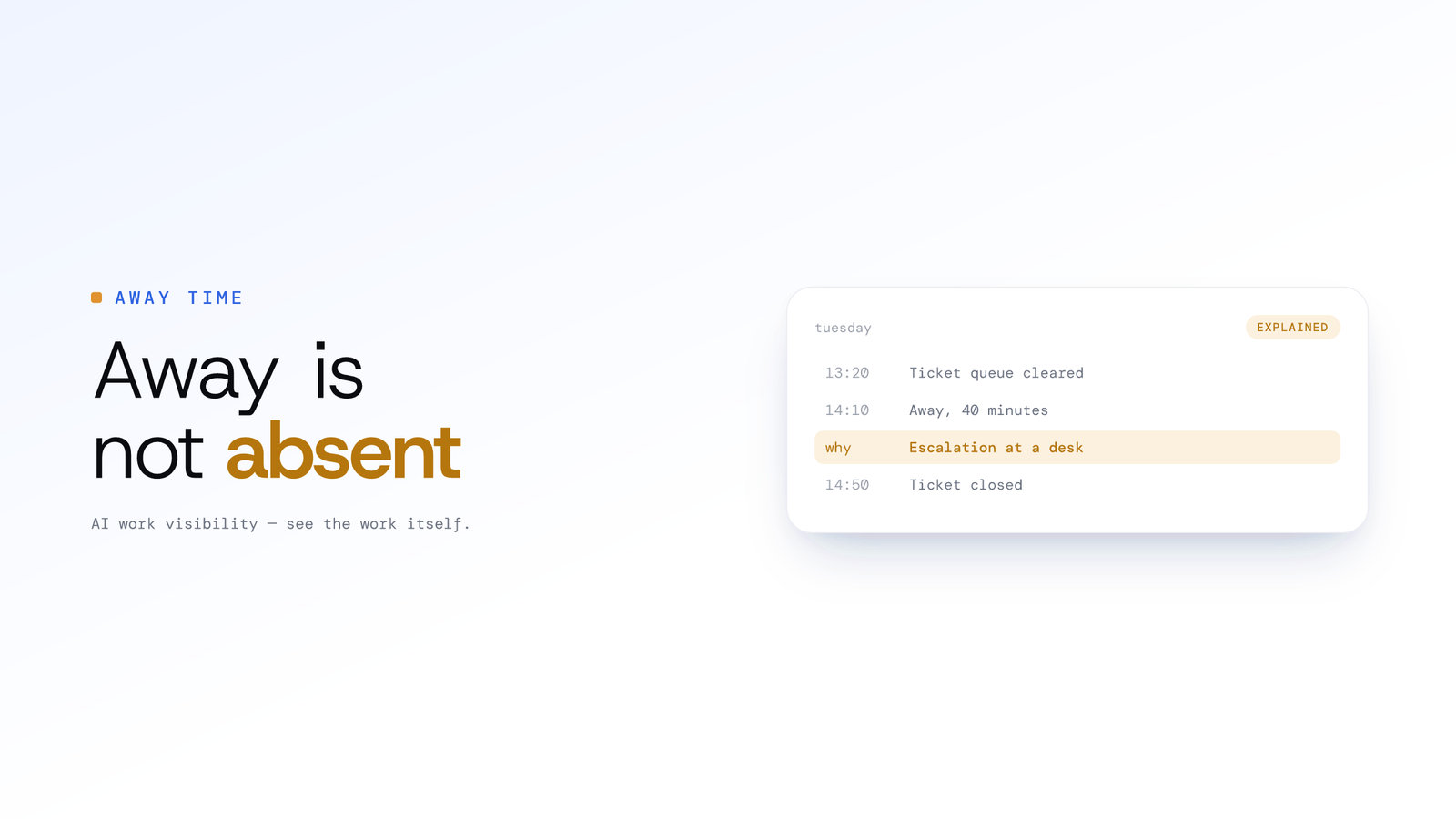
Away Is Not Absent: How Employees Explain Untracked Time
A whiteboard session, a phone call and a long lunch all look the same to a tracker: no input. Here is how ScreenJournal lets the person who was there say what the gap was, and what a manager sees when they do.