ScreenJournal vs ActivTrak
Updated on 14 September 2026
ActivTrak and ScreenJournal both reject heavy-handed surveillance: no keystroke logging, and no stored recording archive by default. The difference is what they measure. ActivTrak scores app and website usage, a proxy for work. ScreenJournal reads the work itself, measures what was actually produced, then deletes the raw screen data by default and keeps a searchable history of the work.
ActivTrak is one of the strongest tools in the activity analytics camp, and this comparison is closer than most in the monitoring market, because both products treat employee privacy as a design constraint rather than an afterthought. That makes the remaining difference easier to see clearly: it is a choice between two sources of truth.
What is ActivTrak?
ActivTrak is a workforce analytics platform that measures productivity from application and website usage. It categorises usage as productive or unproductive, reports active versus idle time, and rolls the results into dashboards and reports. It positions itself as privacy-first monitoring and now includes a conversational AI assistant that answers questions from usage data.
Its capture posture is notably restrained for the category. Screenshots are off by default and available only through the Screen Details add-on, or a Full Details setting per configuration, and captures are triggered by alarms, specific conditions an administrator defines, rather than taken at intervals. There is no keystroke logging at any tier and no continuous screen recording. These facts were checked against ActivTrak's own support documentation before publication.
What is ScreenJournal?
ScreenJournal is an AI work visibility tool that reads on-screen work as it happens, turns it into a detailed timeline of what each person actually did, and then, by default, deletes the raw screen data. Timelines accumulate into a searchable chronicle of everyone's work history, and from them ScreenJournal generates timesheets and reports automatically and drafts standup summaries on request, answering questions about any of it in plain English.
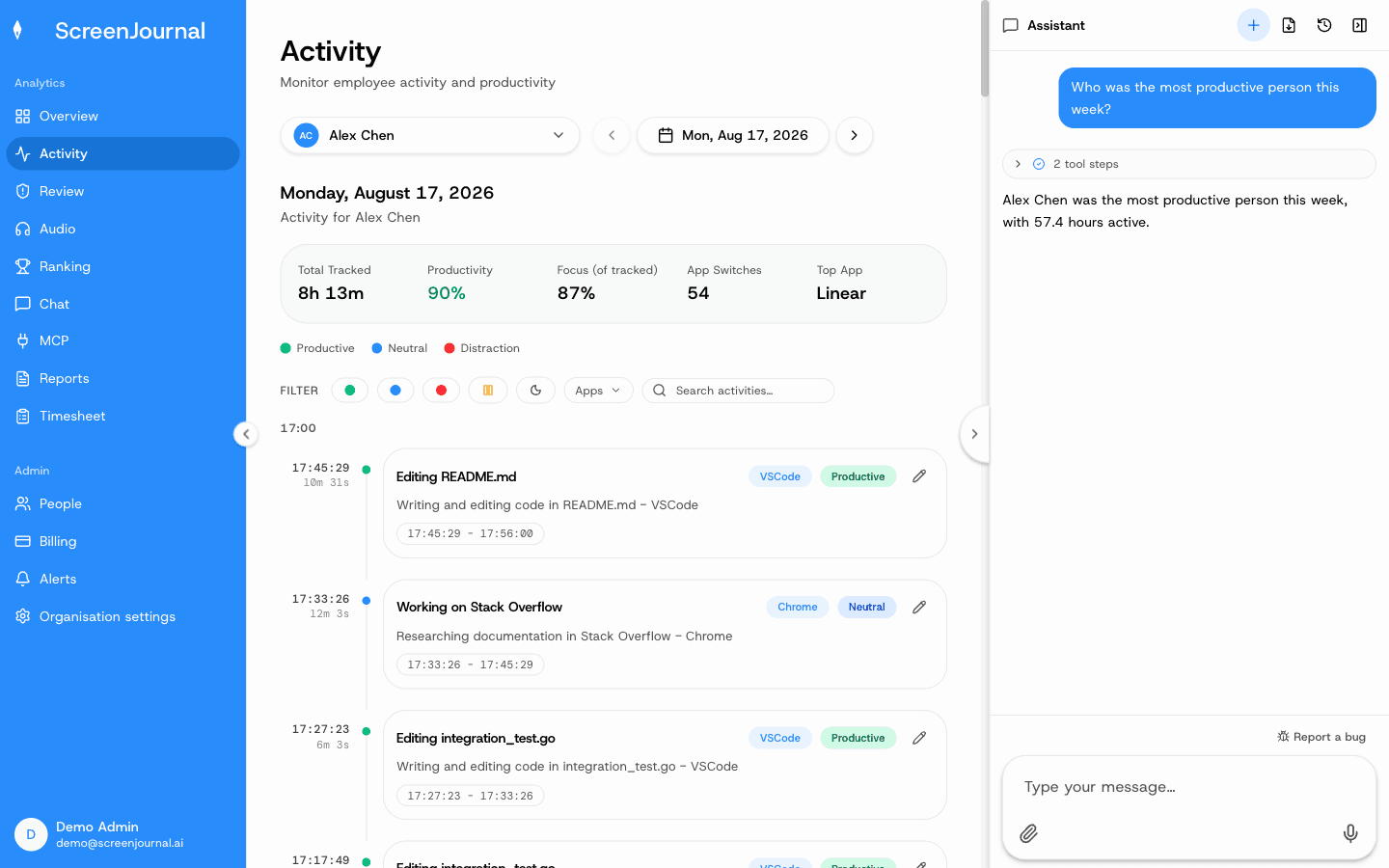
The work timeline is the source record: every entry carries an app badge, a duration, a plain-English summary and a score, and expands for context. Past timelines accumulate into the work chronicle, searchable through chat and MCP and permission-scoped by role.
Proof: the Assistant chat (Ask AI) open beside the dashboard, showing the data it consulted before answering.
How do ActivTrak and ScreenJournal compare?
Both tools avoid the surveillance playbook, so the comparison comes down to what each one measures and stores. ActivTrak measures how applications and websites were used and keeps that usage data. ScreenJournal reads the work itself, keeps the derived timeline, and by default deletes the raw screen data during processing. Where a manager needs video evidence they can opt in to keep the recordings (Evidence Mode), and those recordings are stored for up to 3 months.
The table below sets out the practical differences: what each tool captures and stores, how you get answers, and what each is best at.
| ActivTrak | ScreenJournal | |
|---|---|---|
| What it captures | Application and website usage, active versus idle time; screenshots only when an alarm fires, via an optional add-on | Work activity on screen, read by AI in the moment |
| What it stores | Usage data and productivity categories; alarm-triggered screenshots where the add-on is enabled | Derived timelines, timesheets and reports; recordings are not stored by default, and a manager can opt in to keep video evidence for up to 3 months |
| How you get answers | Dashboards, plus an AI assistant answering from usage data | Ask AI on every page and MCP, answering from the work itself |
| Employee privacy | No keystroke logging at any tier, no continuous recording; usage metadata retained | Excluded apps and sites never captured, PII removed, redaction that erases the entry entirely, no stored footage by default |
| Searchable history | Usage trends and reports by date range | A chronicle of the work, searchable by meaning through chat and MCP |
| Cheating resistance | Time in productive apps reads as productive | Output-based, so activity without output achieves nothing |
| Timesheets | Workforce analytics rather than client-billable timesheets | Computed from tracked hours, with each day opening into the segments behind it |
| Best for | Usage analytics and licence utilisation at scale | Knowing what was produced, with timesheets, reports and history from the same record |
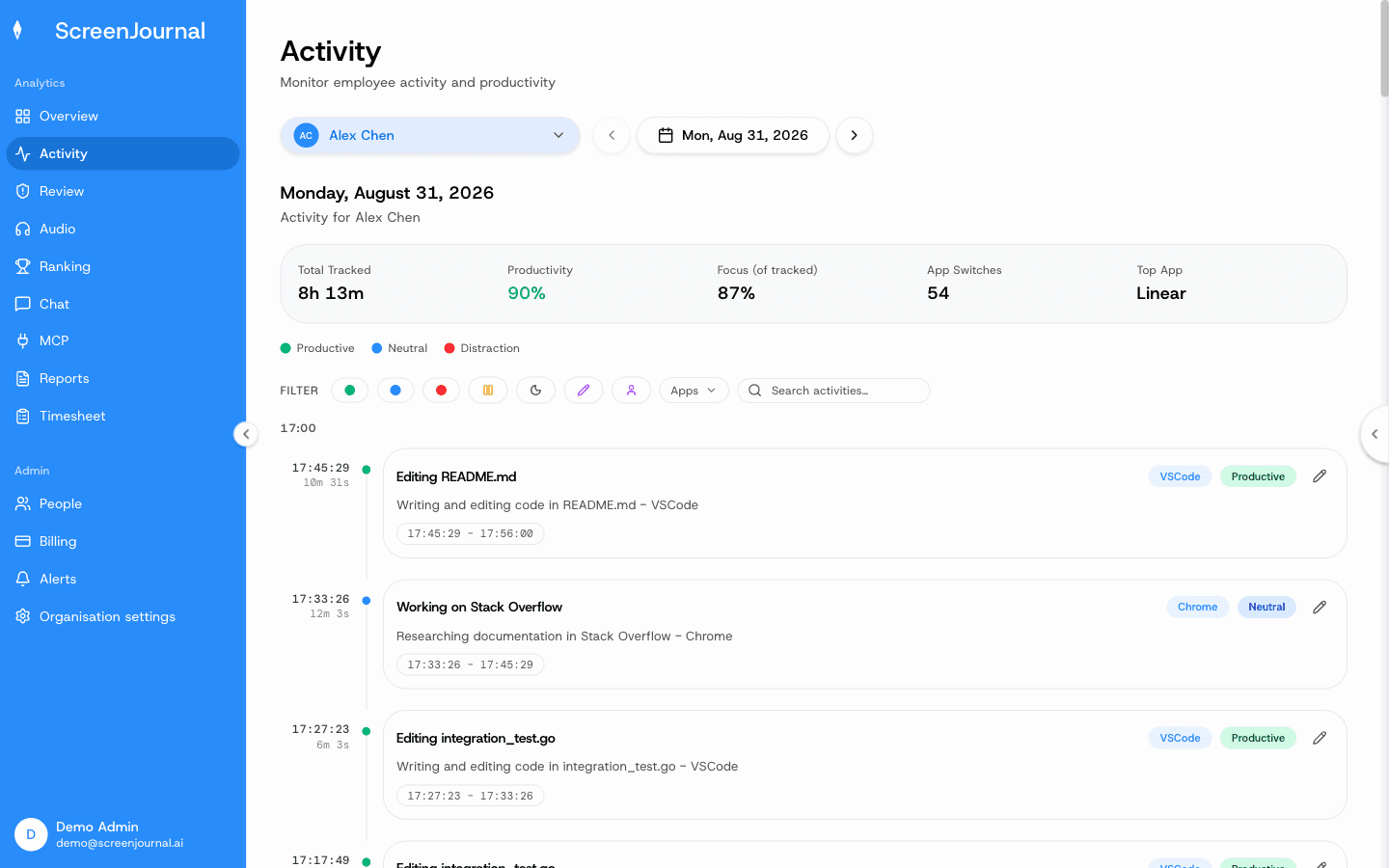
On the employee side, ScreenJournal is built so that visibility runs both ways. Employees see the same activity view managers do, an admin can correct any score the AI misread, and behavioural nudges are off until an admin writes an alert rule. Apps and sites on the organisation's privacy exclusion list are never captured, and anything else can be redacted by whoever the organisation allows. A redacted entry is erased entirely and never appears in anyone's search; who may redact is a permission the organisation's administrators grant, and nobody has it until they do.
Proof: the Activity page, one person's day as scored segments with the app, time range, duration and an AI-written description; hover a segment for Correct score, Play recording and Redact, each gated by role and policy.
Is ActivTrak privacy-friendly?
Yes, by the standards of employee monitoring. Screenshots stay off unless an administrator enables the add-on, nothing is recorded continuously, and keystrokes are never logged. If your shortlist is driven by avoiding surveillance, ActivTrak is one of the reasonable choices. Which is why choosing between ActivTrak and ScreenJournal is not really a privacy decision. It is a measurement decision.
In its default configuration ActivTrak reads less from the screen than ScreenJournal does; it simply never looks at the content of the work. ScreenJournal does read the content, and its privacy design exists precisely to make that safe: capture scoped to work activity, excluded apps and sites never captured, PII removed during processing, employee redaction, and deletion of the raw screen data during processing by default. What remains is understanding, not footage, unless a manager has opted in to keep video evidence.
The payoff for reading the work is what the record can answer. Usage data can tell you that someone spent four hours in a spreadsheet. It cannot tell you whether that was the month-end reconciliation or four hours of drift, and no amount of dashboard tuning closes that gap. A timeline written from the work itself carries the answer directly: which client, which task, what changed. That is also what makes the chronicle worth keeping: a history of app usage is rarely worth searching, while a history of the work answers questions like "how did we fix this last time" months later.
When is ActivTrak the right choice?
ActivTrak is the right choice when usage analytics is genuinely all you want.
- You need app and website usage statistics, capacity and licence-utilisation data across a large organisation, and you prefer a tool that never reads work content in its default configuration.
- Your teams' output maps closely to time in known applications, so app-level categories answer your questions.
- You have no need for client-billable timesheets or a searchable record of the work itself.
When is ScreenJournal the right choice?
ScreenJournal is the right choice when you need operational truth about the work, not a usage summary.
- You need to know what was produced, and app time is a poor proxy for your teams' output.
- You bill clients for team time and want timesheets prepared from real work, reviewed rather than reconstructed.
- You want questions answered in plain English from the work itself, through chat or MCP, instead of interpreting dashboards.
- You want work history to accumulate into something useful: a searchable chronicle rather than usage trends.
Frequently asked questions
Does ActivTrak take screenshots?
Not by default. Screenshots are available through the Screen Details add-on, or a Full Details setting per configuration, and they are triggered by alarms rather than captured at intervals. There is no continuous recording. ScreenJournal stores no screenshots at all: it reads the screen, keeps the derived timeline and deletes the raw screen data by default. A manager can opt in to keep video evidence, stored for up to 3 months.
Does ActivTrak log keystrokes?
No. ActivTrak does not log keystrokes at any tier, and neither does ScreenJournal. The difference between the two lies elsewhere: ActivTrak measures application and website usage, while ScreenJournal reads the work itself and measures output.
How is ScreenJournal's AI assistant different from ActivTrak's?
Both answer questions in plain English. ActivTrak's assistant answers from usage data, so it can describe app time and activity trends. ScreenJournal's Ask AI answers from the derived record of the work itself, so it can say what was produced, how something was done and where the billable hours went.
Can ScreenJournal replace ActivTrak dashboards?
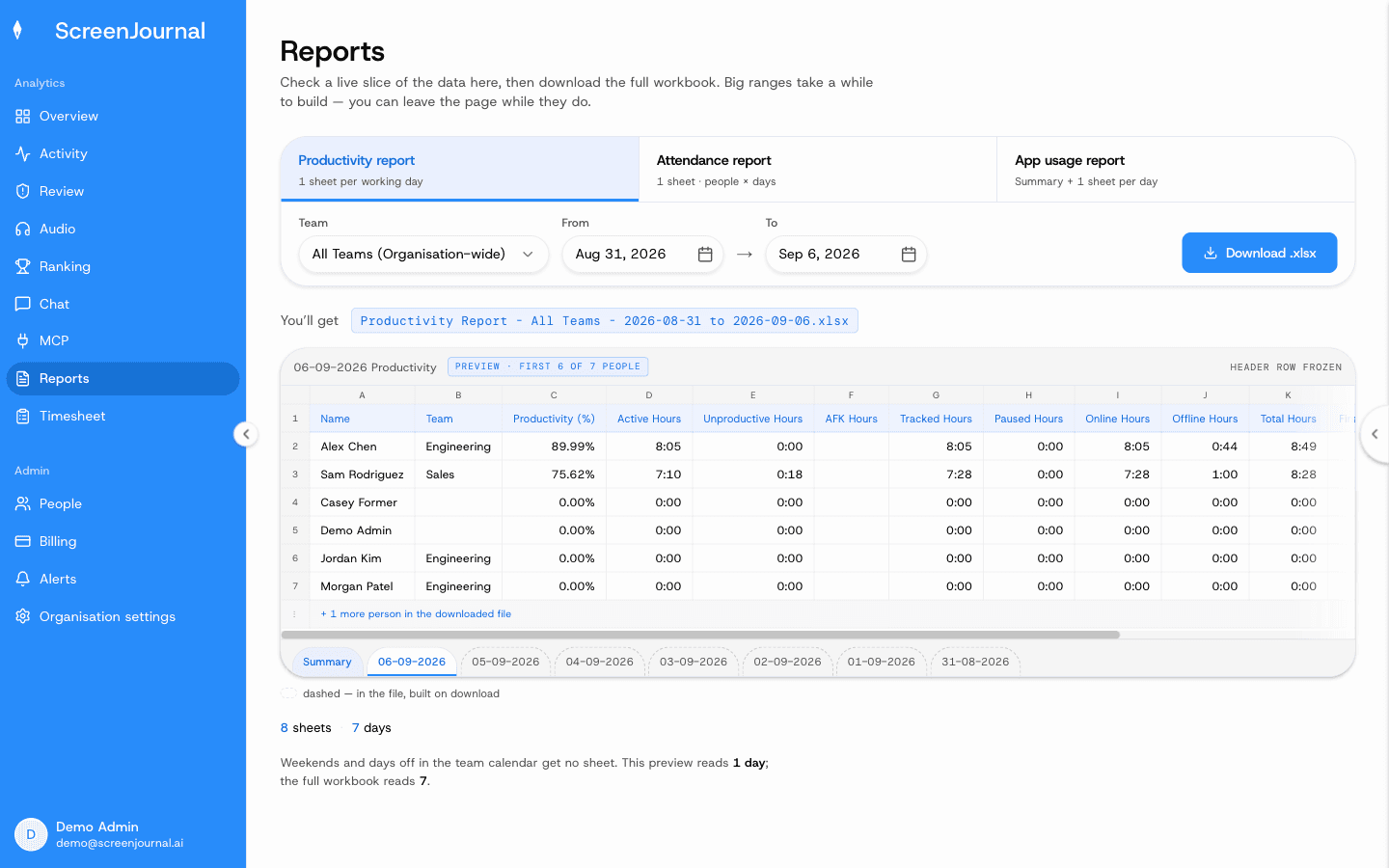
The reporting overlaps: team overview, trends and attendance. ScreenJournal adds what usage analytics cannot: the ability to ask why a number moved and get an answer from the underlying work, plus timesheets and a searchable work history from the same record.
Proof: the Reports page, with the report chooser, scope and date range, and a live preview of the workbook before download.
Which should you choose?
Ask one question of any tool on your shortlist: when you need an answer about work, does the tool give you the answer, or give you data to interpret? ActivTrak gives you well-designed usage analytics, and its AI assistant summarises that usage. ScreenJournal reads the work, answers from it, deletes the raw screen data by default and keeps the history searchable. If usage statistics answer your questions, ActivTrak will serve you well. If your decisions depend on what was actually produced, that is the problem ScreenJournal was built for. For the wider market view, see ScreenJournal vs the alternatives.
See the work itself, not screenshots of it
Timesheets, reports and answers from the work your team actually did. Available for Windows and macOS, with Linux and mobile support coming soon.