Digital Hoarding vs. Digital Insight - Stop Treating Your Employees Like Crime Suspects
Learn why traditional employee monitoring creates security liabilities and how ScreenJournal's AI-first approach extracts insights without storing invasive screenshots or video.
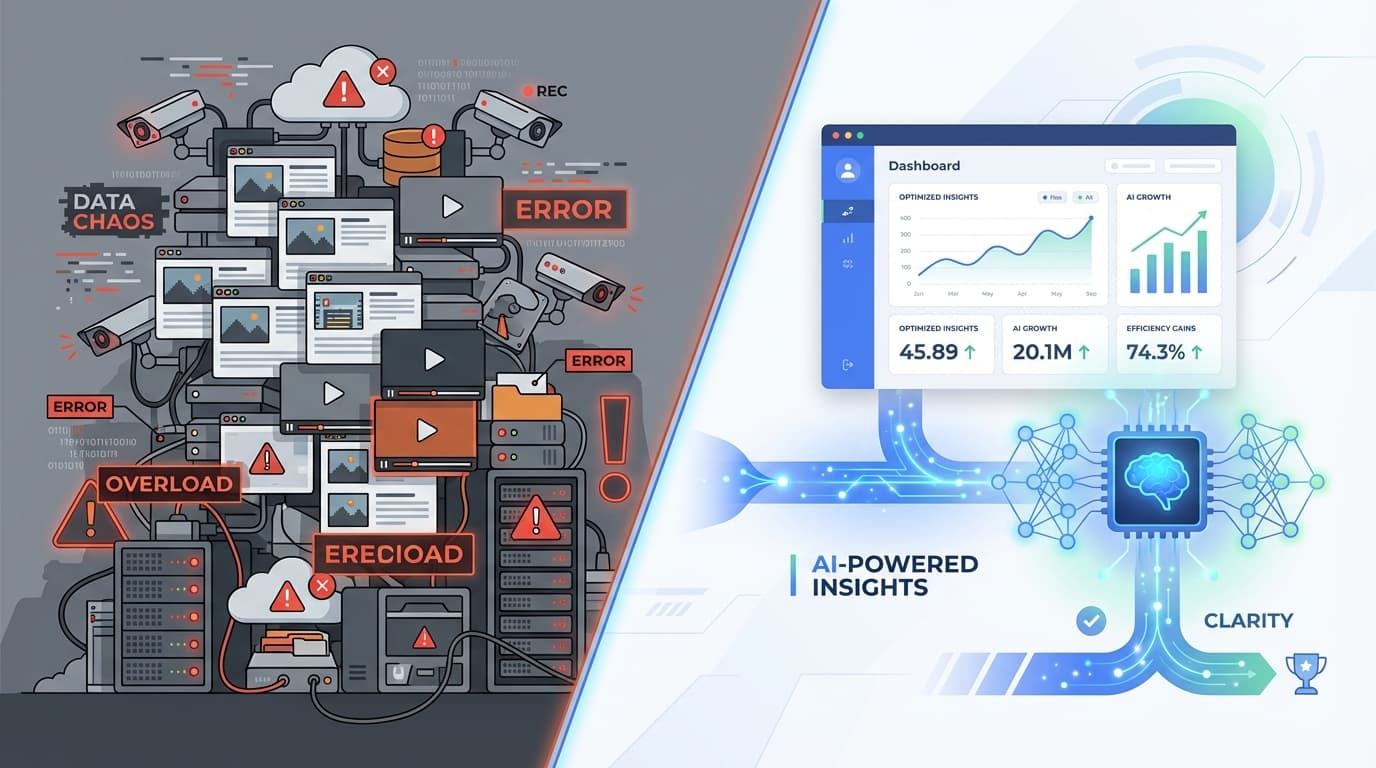
Digital Hoarding vs. Digital Insight: Stop Treating Your Employees Like Crime Suspects
Imagine hiring a sports analyst to help your team improve. But instead of giving you a report on pass completion rates and defensive formations, they hand you 90 minutes of raw GoPro footage strapped to the quarterback's helmet and say, "It's all in there, just watch it."
That is the state of employee monitoring today. Generic employee monitoring tools act as digital hoarders, filling hard drives with screenshots and video streams you will likely never watch, that create massive liability the moment they are stored. They operate like security cameras in a convenience store - recording everything in case a crime happens.
But you aren't running a convenience store. You're running an engineering team. You don't need evidence of a crime; you need insights into performance. This is why ScreenJournal takes the approach of a digital analyst: we watch the game live, extract the stats, and immediately discard the tape.
The Architecture of Hoarding
The industry standard relies on a "capture-and-keep" architecture. It is simple, invasive, and dangerous.
How It Works
- Capture: The agent takes screenshots every 5 seconds or records continuous video.
- Storage: These massive binary blobs (images/video) are uploaded to a cloud bucket (S3, Azure Blob).
- Indexing: A database points to these files with timestamps.
- Retrieval: You have to manually scrub through hours of footage or thousands of images to find "that one bug" or "productivity dip."
The Liability Nightmare
This architecture creates a permanent "Digital Paper Trail" of things you never wanted to record:
- PII Leaks: A screenshot of a customer database or a private email is stored forever.
- Storage Bloat: Storing video consumes terabytes of expensive hot storage.
- Trust Erosion: Your team knows every second is being archived, creating a "surveillance state" culture.
The Architecture of Insight (The ScreenJournal Model)
ScreenJournal flips this model using what we call the Goldfish Protocol: strict short-term memory for video, long-term memory for metadata. We don't want your video. We want the data inside the video.
Our architecture is built to ensure video files literally cannot exist on our servers long-term.
- The Input (Video Chunks): The desktop client records screen activity in short, temporary buffers.
- The Processor (Google Gemini): This is where the magic happens. We send the video chunk to Gemini with a strict prompt: Analyze this workflow. Identify the tools, the context, and the timeline. Do NOT transcribe PII. Output JSON only.
- The Kill Switch: Once Gemini returns the JSON metadata, the video file is immediately and permanently deleted. It never hits a storage bucket. It is not archived. It is gone.
- The Storage (InfluxDB): We store the clean, anonymized text metadata (e.g.,
{"event": "coding", "app": "VS Code", "duration": "45m"}) in InfluxDB, a time-series database optimized for high-volume text events, not binary blobs.
Why Metadata Beats Video
By storing metadata instead of pixels, we move from surveillance to analytics.
| Feature | Generic Tools (Hoarding) | ScreenJournal (Insight) |
|---|---|---|
| Data Type | Screenshots / Video Blobs | Text / JSON Metadata |
| Privacy Risk | High (Captures passwords/chats) | Low (Sanitized by AI) |
| Storage Cost | Exponential (Image storage) | Linear (Text storage) |
| Utility | "What did they see?" | "How do they work?" |
| Review Time | Hours of scrubbing footage | Seconds of reading graphs |
Generic tools give you a pile of hay and ask you to find the needle. ScreenJournal uses AI to burn the haystack and just hands you the needle.
Stop Paying to Store Liability
Every gigabyte of screen recording you store is a potential GDPR violation waiting to happen. It is a monthly bill for storage you will never read. It is a signal to your team that you don't trust them.
Move away from the security camera model. Adopt the sports analyst model. Get the insights, improve the performance, and let the raw footage disappear.
Stop guessing. Start knowing.
Let AI turn screen data into clear insights. Start your 2 months free trial
Related Posts
Privacy-First Employee Monitoring - Building Trust While Maintaining Visibility
Explore how privacy-first employee monitoring creates better outcomes for both employers and employees through transparency, respect, and intelligent AI analysis.

The Goldfish Protocol - Why Our AI Forgets Your Screen Recording Instantly
Discover how ScreenJournal uses the "Goldfish Protocol" to analyze employee activity without storing invasive video. Learn about our privacy-first architecture using Gemini and InfluxDB.
Beyond Screen Recording: Why Voice Analysis is the Missing Piece in Employee Monitoring
Most employee monitoring tools only watch screens. For call centers, sales teams, and support desks, the real work happens through voice. Learn how AI voice analysis closes the visibility gap.